Share
The difference between being right and being trusted
 ‌ ‌ ‌ ‌ ‌ ‌ ‌ ‌ ‌ ‌ ‌ ‌ ‌ ‌ ‌ ‌ ‌ ‌ ‌ ‌ ‌ ‌ ‌ ‌ ‌ ‌ ‌ ‌ ‌ ‌ ‌ ‌ ‌ ‌ ‌ ‌ ‌ ‌ ‌ ‌ ‌ ‌ ‌ ‌ ‌ ‌ ‌ ‌ ‌ ‌ ‌ ‌ ‌ ‌ ‌ ‌ ‌ ‌ ‌ ‌ ‌ ‌ ‌ ‌ ‌ ‌ ‌ ‌ ‌ ‌ ‌ ‌ ‌ ‌ ‌ ‌ ‌ ‌ ‌ ‌ ‌ ‌ ‌ ‌ ‌ ‌ ‌ ‌ ‌ ‌ ‌ ‌ ‌ ‌ ‌ ‌ ‌ ‌ ‌ ‌ ‌ ‌ ‌ ‌ ‌ ‌ ‌ ‌ ‌ ‌ ‌ ‌ ‌ ‌ ‌ ‌ ‌ ‌ ‌ ‌ ‌ ‌ ‌ ‌ ‌ ‌

Transparent AI: Bridging the Trust Gap


Bridging the gap between mathematical confidence and human trust


A model that boasts 99% accuracy is a liability if the human operator can't understand the "why" behind the "what."


This is the trust gap—the chasm between a machine's mathematical confidence and a human's willingness to act on it. Berk Birand of Fero Labs illustrated this in the industrial sector: an engineer responsible for a factory simply won't use software they don't trust when their job and the factory's profitability are on the line. If a black box recommends a steel mixture that results in a batch of insufficient strength, the financial cost runs to hundreds of thousands of dollars—and the engineer is held responsible, not the algorithm.


This hesitation isn't unique to manufacturing. Dean Freestone of Seer recounted building epilepsy algorithms in a hospital setting: technicians loved the tool when he was in the room to explain it, but stopped using it the moment he left. They lacked the trust to rely on it independently. Konstantinos Kyriakopoulos of DeepSea noted that no captain operating a vessel worth hundreds of millions of dollars will trust speed and route decisions to a complete black box without a view of how it's thinking.


Three Concepts We Keep Conflating


To bridge the trust gap, we need to distinguish between transparency, interpretability, and explainability—terms often used interchangeably but serving different purposes.


Transparency means knowing what's in the box: the data, weights, and processes used to build the model. Yiannis Kanellopoulos of Code4Thought describes this as "last mile analytics," enabling independent auditing to ensure the system isn't making decisions based on irrelevant artifacts—like predicting “wolf” based on background snow rather than the animal itself.


Interpretability means understanding the logic: seeing the specific features the model used to reach a conclusion. Aaron Morris of PostEra explained that for chemists managing large budgets, it's not enough to know a molecule is a match—they need to know which structural features drove that prediction. Berk Birand achieves this by displaying familiar physics curves showing that adding carbon increases steel strength, allowing engineers to verify that the model's logic aligns with their textbook knowledge.


Explainability means translating for the user: converting output into human-relevant terms. Nico Karssemeijer of ScreenPoint Medical argued that radiologists aren't interested in algorithmic mathematics; they need explanations in their own language, for example, describing a lesion as a “calcified area” and marking its location. Junaid Kalia of NeuroCare.AI emphasized that if an AI recommends against prescribing a medication, it must explain why (e.g., the patient had a reaction three years ago) for the doctor to trust the output.


Impactful AI isn't just about being right—it's about being auditable.


Different Stakeholders, Different Evidence


Transparency isn't one-size-fits-all. Different audiences require different types of evidence to trust a system.


Professional users need actionable interpretability. Dirk Smeets of icometrix emphasized that the goal is augmentation, not replacement: quantifying exactly what the AI sees that the human eye might miss, presented as objective data rather than black box opinion.


Executives and buyers need process transparency. Yiannis Kanellopoulos described AI due diligence, in which investors require independent audits to verify that models are statistically fair, robust to drift, and not reliant on spurious correlations.


Beneficiaries—patients, citizens—need agency. Leo Grady of Jona uses AI to create digital twins that answer “what if” questions: What does the vegan version of this patient look like? What about keto? This turns complex diagnoses into actionable choices.


Developers need explainability for debugging. Harro Stokman of Kepler Vision recounted how their fall detection AI was confused by a hat and coat hanging on a wall, mistaking them for a person. Visualizing what the model focused on revealed the edge case and drove targeted improvements.


Why This Is a Strategic Imperative


Transparency isn't merely an ethical preference—it's a strategic requirement.


For safety: Simon Arkell of Ryght warned that generative AI can be confident about wrong answers, making hallucinations difficult to detect without attribution that allows humans to verify source data.


For adoption: Ángel Alberich-Bayarri of Quibim observed that adoption rates skyrocket when doctors understand training cohorts and model behavior. Without this trust, even highly accurate systems get ignored.


For compliance: Todd Villines of Elucid noted that regulatory bodies like the FDA require robust evidence of generalizability. Yiannis Kanellopoulos added that in finance, explaining why a credit application was denied is a legal condition for operation.


For improvement: Amy Brown of Authenticx utilizes interfaces that let clients agree or disagree with predictions, creating feedback streams that continuously tune models.


The Transparency Paradox


There's a myth that you must choose between accurate black boxes and explainable but weaker models. Leaders in high-stakes fields are finding the opposite.


Rafael Rosengarten of Genialis argued that simpler architectures operating on 20-50 genes often outperform deep networks ingesting thousands of data points. These sparser models avoid overfitting and enable physicians to understand the biological patterns that drive predictions. Greg Mulholland of Citrine Informatics challenged the obsession with statistical perfection: a slightly less accurate but explainable model can “unlock new thinking in a scientist's mind,” leading to next-generation products rather than static predictions.


But transparency must not be confused with total data visibility. Sean Cassidy of Lucem Health warns that clinicians are already besieged by notifications—they don't want more flashing lights interrupting care delivery. Dean Freestone uses machine learning not to show doctors terabytes of EEG data, but to create a highlight reel of relevant seizures. True transparency means curating output to be actionable.


In Conclusion


Impactful AI doesn't hide behind complexity—it thrives on clarity. It's not enough for a model to produce the right answer; it must produce it for the right reasons. As John Bertrand of Digital Diagnostics warned, without transparency, developers risk sharp shooting—slamming data through a system until they get an accuracy metric that feels good, creating a correlation engine rather than causal understanding. A model that works by accident or proxy is fragile; a model that works by understandable, verifiable logic is robust.


Transparency is what transforms AI from a black box into an open book—allowing experts to verify that the machine's logic aligns with the physical and biological laws of the real world. It's how we bridge the gap between mathematical confidence and human trust, turning predictions into decisions people are willing to act on.


- Heather

Vision AI that bridges research and reality

— delivering where it matters


Article: Foundation Models


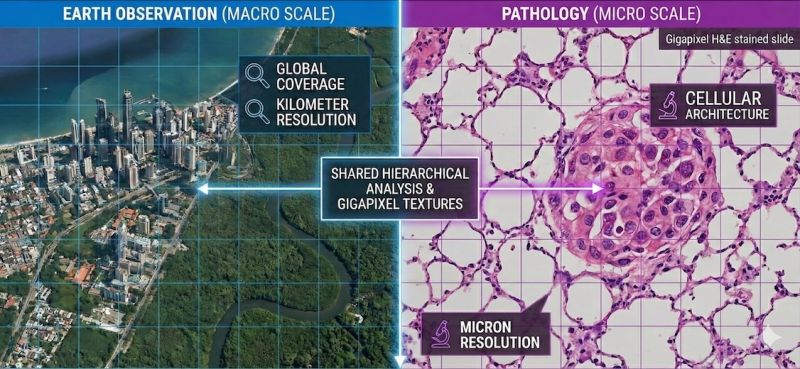
Pathology and Earth Observation: The Convergence and Divergence of Vision Foundation Models


Can a single AI architecture truly master the entire scale of our world?

At first glance, a satellite image of the Amazon and a biopsy of a tumor have nothing in common.

One measures the pulse of a continent.
The other, the mutations of a single cell.

Yet, they are both locked in the same high-stakes race: The quest to build the definitive universal vision backbone.

I just published a deep dive into the convergence and divergence in these fields:

  • Pathology is consolidating. Industry giants like Paige and Bioptimus are building massive, 2B+ parameter models. They use a specific architectural recipe to cancel out technical variations and find biological signals in messy, unstandardized data.

  • Earth Observation is exploding. It’s a cambrian explosion of experimental diversity. From IBM/NASA’s Prithvi to Google’s AlphaEarth, the focus is on multimodal flexibility—integrating radar, thermal, and optical sensors to create a cohesive planetary embedding.


Why the split?
It’s not just technical taste. It’s a direct consequence of:
1) Data access: the open commons vs. the siloed vault
2) Standardization: physical calibration vs. technical variations
3) Institutional incentives: product-led stability vs. research-led innovation

The most exciting part? These two worlds would benefit from cross-pollination. Pathology could benefit from multimodal and multiresolution logic, while EO is learning to build models that ignore geographic bias.

A foundation model is not a one-size-fits-all hammer. It’s a mirror reflecting the unique constraints of the field it serves.

Research: Multimodal Foundation Models


The Molecular Turn: Why Pathology AI is Moving From Big to Dense


For two years, the industry chased scale—training vision encoders on millions of slides to spot morphological patterns. But a new wave of research suggests that multimodal density (pairing images with molecular ground truth) is more valuable than brute-force parameter scaling.

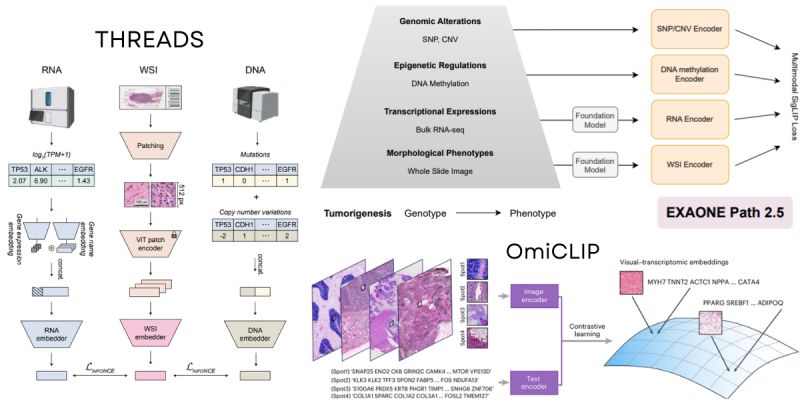
Three new papers illustrate this pivot toward Visual-Omics Foundation Models:

Efficiency Over Scale: Anurag Vaidya et al. introduce THREADS, a model trained on the largest paired dataset to date. Crucially, the authors report that despite being 7.5× smaller than GigaPath and 4.0× smaller than PRISM, THREADS outperforms them on oncology benchmarks. By introducing molecular prompting—retrieving cases based on molecular prototypes rather than text—it proves that biological grounding yields better representations than massive vision-only pretraining.

The Loki Platform & Gene Sentences: Weiqing Chen et al. present OmiCLIP and the Loki platform. Their innovation is treating transcriptomics as language: they convert gene expression into sentences of gene symbols to leverage text-based contrastive learning. Trained on 2.2 million tissue patches, Loki enables zero-shot tissue annotation, effectively allowing researchers to virtually stain H&E images for specific molecular markers without wet-lab costs.

Structural Awareness & Epigenetics: Juseung Yun et al. unveil EXAONE Path 2.5, expanding the modality scope to include epigenetic data alongside genomics and transcriptomics. Recognizing that standard transformers often lose spatial context, they introduce Fragment-aware Rotary Positional Encoding. This preserves the topological structure of tissue fragments, ensuring the model understands the physical layout of the slide while aligning it with multi-omics signals.

Are we witnessing a correction in the scaling laws of pathology? Data quantity is being replaced by data density. The future might belong to models that don't just see tissue, but read its molecular signature.

Molecular-driven Foundation Model for Oncologic Pathology

A visual–omics foundation model to bridge histopathology with spatial transcriptomics

EXAONE Path 2.5: Pathology Foundation Model with Multi-Omics Alignment

Research: Scaling Foundation Models


The Scale-Up Era: Three New Foundation Models Redefining Computational Pathology


Computational pathology has established a solid technical baseline: self-supervised vision transformers trained on gigapixel whole-slide images (WSIs) are now the standard engine for extracting features. However, a raw encoder is not a diagnosis.

Four new papers illustrate the field's shift from pure architectural research to solving the practical barriers of clinical deployment—specifically scale, hardware efficiency, and data accessibility.

Here is how the latest research ties together to address the deployment gap:

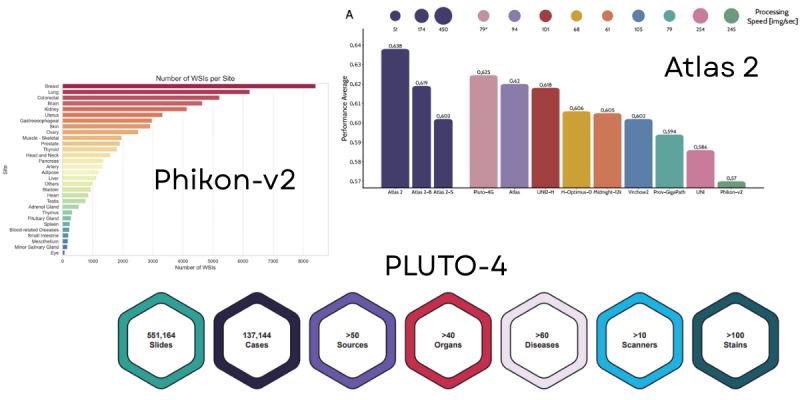
Solving the 'Long Tail' with Extreme Scale: Biological variability is the enemy of AI robustness. Maximilian Alber et al. present Atlas 2, addressing this by training on the largest known dataset to date: 5.5 million WSIs aggregated from Charité, LMU Munich, and Mayo Clinic. The study focuses on robustness across 80 public benchmarks, releasing three model variants (Atlas 2, 2-B, and 2-S) that allow users to optimize the specific trade-off between resource efficiency and invariance to scanner-induced artifacts.

Optimizing for Hardware Constraints: A high-performing model is useless if it is too slow for the clinical workflow. Harshith Padigela et al. unveil PLUTO-4, a family of models trained on 551k WSIs. Recognizing that different settings have different hardware limits, they introduce two specialized architectures: a Frontier model (PLUTO-4G) for maximum representation, and a compact model (PLUTO-4S) utilizing FlexiViT with 2D-RoPE embeddings. This compact architecture is specifically optimized for high-throughput deployment, while the frontier model achieved an 11% diagnostic improvement in difficult domains like dermatopathology.

Democratizing High-Performance Features: Does state-of-the-art performance require proprietary hospital archives? Alexandre Filiot et al. argue no with Phikon-v2. Trained on 460 million tiles exclusively from public cohorts, this feature extractor matches the performance of models trained on massive private datasets. Methodologically, they introduce a simple but robust ensembling strategy for downstream training that yields statistically significant performance gains without changing the underlying architecture.


PLUTO-4: Frontier Pathology Foundation Models

Atlas 2 -- Foundation models for clinical deployment


Phikon-v2, A large and public feature extractor for biomarker prediction

Enjoy this newsletter? Here are more things you might find helpful:


Pixel Clarity Call - A free 30-minute conversation to cut through the noise and see where your vision AI project really stands. We’ll pinpoint vulnerabilities, clarify your biggest challenges, and decide if an assessment or diagnostic could save you time, money, and credibility.

Book now

Did someone forward this email to you, and you want to sign up for more? Subscribe to future emails
This email was sent to _t.e.s.t_@example.com. Want to change to a different address? Update subscription
Want to get off this list? Unsubscribe
My postal address: Pixel Scientia Labs, LLC, PO Box 98412, Raleigh, NC 27624, United States


Email Marketing by ActiveCampaign